Black Girls Disproportionately Confined: We Need Mentoring!

mmorris

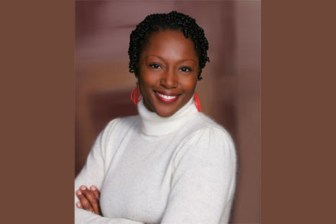
Monique W. Morris, Ed.D.


Welcome to 2014!  It’s January which means it’s National Mentoring Month!  This month, I’ll be sharing ideas, tips, and stories to promote awareness of mentoring and enticing more adults to get involved in mentoring relationships and programs with young people.  

I’m sharing a story that was originally published in BlackNews.com by Monique Morris, Ed.D., author and co-founder of the National Black Women’s Justice Institute.  The article highlights research demonstrating that African American girls continue to be disproportionately over-represented among girls in confinement and court-ordered residential placements. The article also reports they are also significantly over-represented among girls who experience exclusionary discipline, such as out-of-school suspensions, expulsions, and other punishment.  CLICK HERE TO READ THE STORY!

My purpose in sharing this piece is to inform, provide food for thought, and to serve as a call to action by illustrating, that based on our experiences and this research, how desperately our girls are in need of mentoring and advocacy to support their self-improvement as individuals, but also to ensure that they receive the proper support and education from the institutions in which they are educated. 

Please share your thoughts below! And, spread the word about the importance of mentoring throughout the month of January!

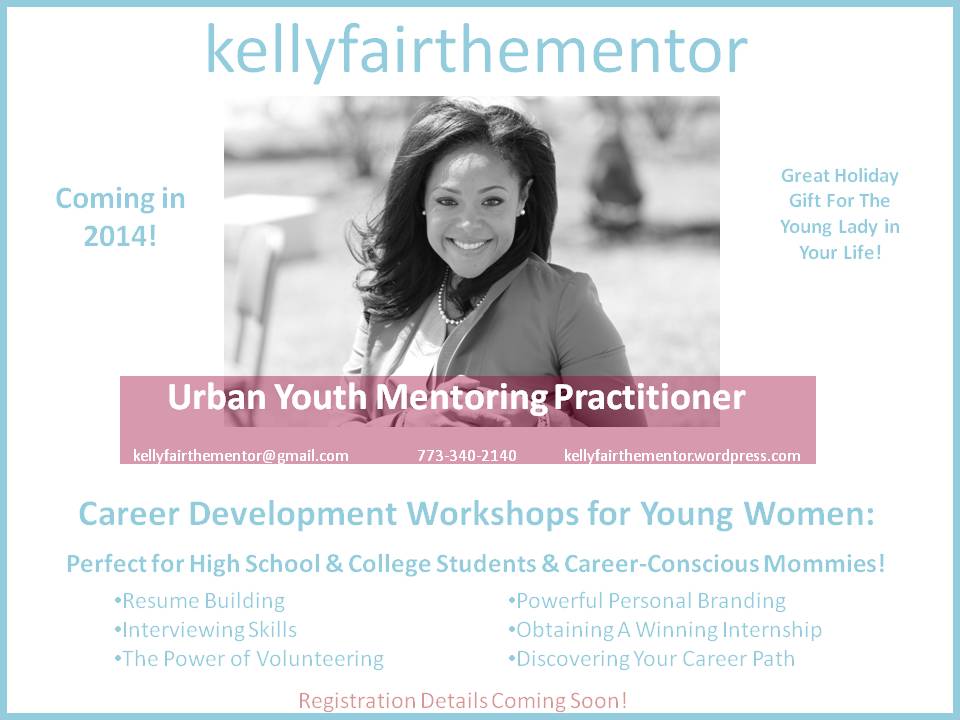
Kelly

KellyFairTheMentor

kellyfairthementor@gmail.com


Meet Pertesha!: From Foster Care & Fighting to Finding Success!

Since 2009, my girls mentoring program, Polished Pebbles, has positively changed the lives of over 600 girls. Girls in Polished Pebbles receive 60-120 hours per year of interaction and learning with positive role models. These young ladies build relationships over time during sessions held directly in their own schools or communities that help to positively affect their lives. 

An example of just one of the many success stories of Polished Pebbles is Pertesha. After joining Polished Pebbles, Pertesha made many personal improvements that helped change her life from when she was in high school to where she is now.

A Polished Pebbles’ alumna, Pertesha sat down with me to discuss how being in Polished Pebbles and involved in programs such as the Bloomingdale’s Brown Bag Apprenticeship Program impacted her life.

THIS IS A STORY THAT SHOULD GO VIRAL! Please share and consider giving to Polished Pebbles Girls Mentoring Program this holiday season by clicking here:  www.gofundme.com/PolishedPebbles.com

I thank you for loving our girls, and your continued support!

Kelly

KellyFairTheMentor

Check Out My Jet Magazine Interview on Stopping “The Sharkeisha Effect”!

sharkeisha effect

Check out my interview with Kyra Kyles of Jet Magazine about stopping the “Sharkeisha Effect.”  See what I have to say about the newly found fame of an unfortunate young lady that has been ridiculed and mocked all over the world wide web.

Read Kelly’s Interview!

Our Social Service Samurai: Dan Bassill

Bassill2013

When I initiated my quest to start my own mentoring program, Polished Pebbles, I searched for veterans in mentoring and non-profit management who would be willing to chat with me and give me some advice.  One of those individuals who took the time to provide me with guidance was Dan Bassill of  Cabrini Connections, Tutor/Mentor Connection program.  For years, I have respected his commitment and efforts to really define mentoring as a recognized industry and profession both nationally, and especially locally in Chicago.  I thought he’d be an excellent candidate to be our first honoree in our new feature Social Service Samurai, where we highlight individuals who are doing stellar work to enhance the field of youth mentoring.

Daniel F. Bassill, D.H.L., occupies a prominent niche in the Chicago youth advocacy arena. His expertise is sought by organizations striving to do what he has done for over 36 years: lead comprehensive, volunteer-based, non-school tutoring and mentoring programs serving inner-city children and youth. His hands-on leadership in both the business and nonprofit realms makes him a premier “go-to guy” for counsel on the newest, most innovative facets of development, sustainability and efficacy for community-focused tutor/mentor programs.

-Tell me about Tutor Mentor Institute; how/why you started the organization; what is its mission statement. Goes back 40 years ago when I came to Chicago to start an advertising job at Montgomery Ward Department Stores.  I was  recruited to be a volunteer tutor for a program they had for youth in Chicago. From 1975-2011 I spent every fall recruiting volunteer tutors and kids and keeping them together as mentoring matches. I began to reach out in 1976 to other people leading tutor/mentor organizations to learn from each other. Our volunteer program grew from 100-300 kids from 1975-1990. I used my skills in mass communications and advertising to promote how to support our kids and mentors to help each other.

This experience taught me, that the only person who could talk knowledgeably about tutor/mentor organizations around the city, and connect those invested individuals/organizations was the person who had the list of all the programs. And, at that time, no one was doing that. Newspaper stories and editorials would sensationalize problems with youth, but didn’t intend to draw readers to places where they go to help  solve the problem.

I left Montgomery Ward in 1990 and converted the tutoring program there into a non-for-profit. I wanted to share this idea of helping mentoring programs all over the city. In 1992 I left that program, and created an older kid version of the original program called Cabrini Connections. Tutor-Mentor Connection started shortly after in 1993.

The mission of the Tutor/Mentor Connection is to gather and organize all that is known about successful non-school tutoring/mentoring programs and apply that knowledge to expand the availability and enhance the effectiveness of these services to children throughout the Chicago region.

Tutor Mentor Connection works directly with organizations not with kids.  Our volunteer base is focused on, and consists of, volunteers from programs and organizations who come together to learn together. We’re trying to drive volunteers and dollars into every neighborhood. The tutor/mentor program locator on our website is built by a volunteer in India. We have volunteers and connections from all over the world, not just in Chicago.

Additionally,  Dan and his organization are responsible for organizing extremely successful Tutor/Mentor Leadership and Networking Conferences.  They actually just held their 40th conference in 20 years.   The conferences connect leaders and supporters of volunteer-based tutoring, mentoring, and education-to-career programs with each other; building visibility so that more volunteers and donors will choose to support tutor/mentor programs in the Chicago region; and help Dan, and his team maintain a current database of existing Chicagoland tutor/mentor programs to share with the general public.

samurai

-What advice do you have for people who are interested in mentoring youth and working for youth advocacy?  The first step is to create a learning process, if someone is thinking of starting a program first thing they should be doing is look at research and other programs and learn what they do/what works best. Begin to synthesize own vision and own strategy. Second step build a team of people so not doing it by yourself. If you have a team of people and do your own research, then build own strategy and own structure. Then [consider] the logistics, when, where, etc. Once you get started you never stop learning. Track own participation and own outcomes, look at what other people do. Use that information to get better. The Internet is good for people coming into this industry, learning what other people do and how they work. Keeps you involved. This energizes you. From these connections people will give social/emotional support; that’s what keeps you involved.

You can find more information about Dan and connect with him on LinkedIn: www.linkedin.com/in/tutormentor/
Read his blog at tutormentor.blogspot.com, and visit his web site at http://www.tutormentorexchange.net 

Renisha McBride: CAUTION!! Black Girl Approaching!!

RenishaMcbride

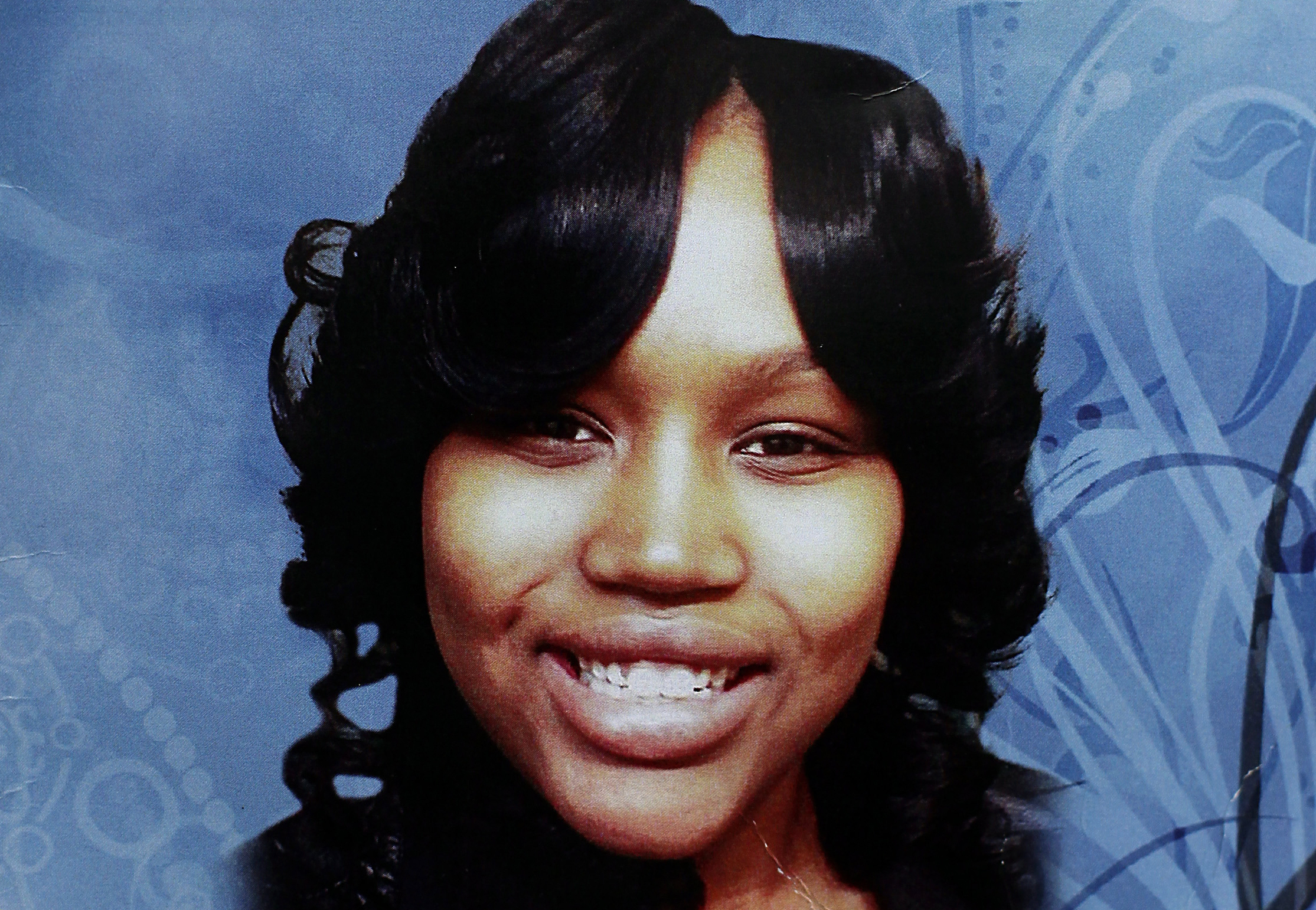
The first time I saw this picture on the news I had to do a double-take.  This young lady looked so familiar. Every time I look at this picture I see the face of one of the girls that live on my block, the girls I pass waiting on the bus stop, or the girls in the halls of the schools I support here in Chicago.  And, more than anything when I see this picture, I feel like I’m gazing into the eyes of the over 500 girls I’ve served through Polished Pebbles Girls Mentoring Program. Renisha McBride may have been a teenager living in Detroit, but ultimately she could have been one of my girls, and perhaps one of the girls in your community too. 

If you’re not familiar with the Renisha McBride story, she’s the 19-year-old young woman who was shot and killed while seeking help after a single car accident she had been in. The accident occurred in the Dearborn Heights neighborhood, a suburb of Detroit. When McBride stepped on 54-year-old Theodore Paul Wafer’s porch knocked on his door for assistance early on the morning of November 2, the man, in his home, wound up shooting her from a distance claiming it was an accident and he feared that she was trying to break in. Wafer has since been charged with murder in the second degree, manslaughter and possession of a firearm. Many have labeled this to have been an instance of racial profiling, and the prosecutor in the case made the following statement:

“We obviously do not feel that the evidence in this case reveals that the defendant acted in lawful self defense.There is no evidence of forced entry into the home. Our evidence shows she knocked on the locked screen door. The charging decision has nothing to do whatsoever with the race of the parties. Whether it becomes relevant later on, I don’t know.”

Autopsy reports of the 19-year-old show that McBride’s blood alcohol content was three times the legal driving limit for the state of Michigan and that she had marijuana in her system when she was driving. As for the shooting, many believe that it was motivated by race; that Wafer possibly saw a black woman standing on his porch late at night and assumed the worst. But her family and community just want to know why his initial reaction was to shoot first.  Their attorney, Gerald Thurswell, spoke out for the family:

“If he had called 911 when he heard her outside his house, they would have been there within two minutes and she would be alive today. Maybe she would have been arrested for being intoxicated, but she would not be dead.”

The 19-year-old had just received a job at Ford after graduating from high school, and her family reportedly described her as an outgoing and friendly young woman.
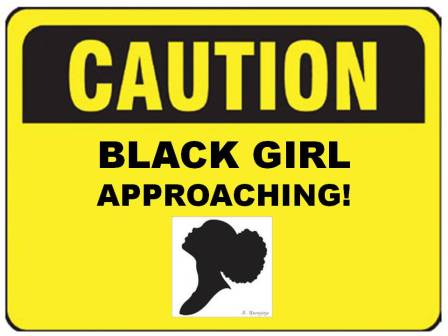
CAUTION Black Girl

I learned about Renisha’s story as I watched some of my favorite public affairs news shows and they were discussing the similarities between this case and the racial profiling in the shootings of other unarmed black teens such as  the highly publicized Trayvon Martin and Jonathan Ferrell cases.  But, they also talked about a prevalent “fear and loathing of black bodies” and it seems that black boys like Trayvon are vulnerable, but now after Renisha’s case it seems that black girls are just as vulnerable in our society.  Many media outlets have been linking this case with the many prevalent and historical stereotypes about black women as being overly aggressive, less feminine  and more masculine, being most useful as the sturdy women who have served as domestics for many years.  These stereotypes that seem to affirm beliefs that black women can not be considered as possible victims of rape, or quite simply that black women in our society are in fact in less of need of help, or protection.  One of the discussions even asserted that its stereotypes such as this that could lead someone to see a 5 foot and 4 inches, 19 yr. old teenage- girl like Renisha McBride as threatening enough to shoot.  I found many of the points and conclusions in these arguments to be convincing, and have some validity.  But, it all got me to thinking a little bit deeper about this situation regarding how black girls in America are viewed.  As an African American woman, it may seem more obvious that I could understand the likelihood of Renisha being racially profiled in a predominately white suburb of Detroit.  This seems to be a more likely story and unfortunately, all too familiar story.  But, what’s more alarming is how I’ve observed how black girls are being negatively profiled by members of our OWN community.

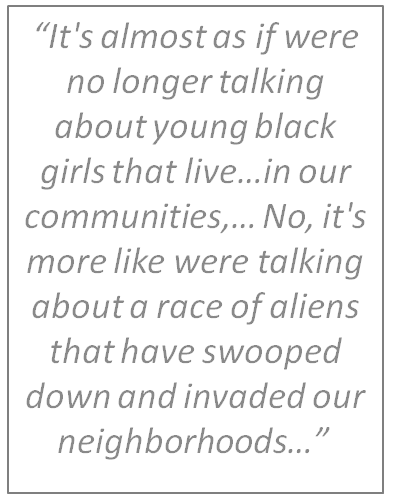
After over 10 years experience in education and youth development, and over 4 years running Polished Pebbles Girls Mentoring Program, I’ve gotten to know lots of wonderful young ladies and their families.  When I’m out and about and I tell people about my career mentoring girls here in Chicago, I frequently get many “pats on the back” and receive sentiments of genuine sincere support and appreciation for my work.  But, that expressed appreciation is many times also decorated with tones of disdain and disapproval about the current state of black girls.  People are so quick to say to me things like “Good, THOSE girls need it”,or “THOSE girls are lost.” And, I often think to myself, when did the girls living in our communities stop being OUR girls and become THOSE girls?  It’s almost as if were no longer talking about young black girls that live and are educated in our communities, and our cities, and essentially products of us as a people.  No, it’s more like were talking about a race of aliens that have swooped down and invaded our neighborhoods with disrespectful and unmotivated approaches to their own lives and lives of others.  And, we don’t know how these alien black girls got here, and why they act the way they do.  black girls are aliens

It just feels like far too many of us in the African American community have a real discomfort, and honestly a disconnect with our own girls.  We’re so frustrated with what we’re seeing as the end product in their some times inappropriate dress, appearance, attitude, and seeming lack of aptitude. I mean, I get it, and understand the frustration.  I’m on the front lines of it all through my daily work.  But, what’s troubling to me is that we’re not willing as a community to do the hard work of being non-judgmental and understanding enough to be honest about the reasons why our girls do what they do. When you work day to day with youth as I have over the last ten years, you get a better sense of why the surface behaviors that we often associate with our girls exist. That young lady on the bus stop is loud, because it’s a defense mechanism she’s developed to defend her reputation and earn respect in her neighborhood.   She’s quick with her tongue, and fast to get snappy with you because she can’t trust anyone.  She doesn’t trust anyone, because in many instances the initial people who were supposed to love her, nurture her, and help her learn what true trust and love could look like, abandoned those responsibilities, and essentially she’s raising herself.  And, when you’re living in a community with an under resourced schools  and economic opportunities you’re already at a disadvantage at being less aware of opportunities that may be available to you.  So, why dress any different? Why aspire and participate in activities that happen in a world seemingly so far far away from your day-to-day survival?   

It just seems sometimes at times that it’s no love our her for our black girls.  I reluctantly “get called out” and get drawn in social media debates about the state of black girls and black women.  Often the tones are very accusatory, lack empathy, and don’t involve any real desire to identify the root causes for these challenges.  And, I walk away saying, when did so many of us in our community feel like it was okay to fall in the stereotypes too, and think that our black girls don’t need to be protected, don’t need to helped, and just don’t need to be loved?  But, if we won’t be sensitive enough to love them in even really tough times such as this, then who will? We may not have the man that pulled the trigger on Renisha McBride, but perhaps the self esteem and hope of a young black girl in our community dies every time we refuse to place judgement to the side, learn her story, and help her.  And, how do we learn that story of that girl you ask?  MENTOR!! Get involved with a mentoring organization and volunteer, or at the very least support their work in some way.  

And, we need as much support as we can get.  At Polished Pebbles, we’re working with our girls to learn how to overcome the challenges they face as black girls in our communities by developing effective communication skills, and the necessary confidence.  We have been able to follow a network of girls, but with decreased funding due to a tough economy and frequent budget cuts to already under-resourced communities and educational systems, it is becoming tougher to do that. As you can see below, our operating budget has been slashed significantly by almost 70% .

budget cut

We are doing our best to maintain those relationships and continue to serve almost the same amount of girls on a budget that is five times smaller than what we operated on last year. However, we need your help. In just four years Polished Pebbles has grown to serve over five-hundred girls, and we want to continue to be able to serve this amount and more!

Please donate to Polished Pebbles so we can continue to serve young girls and provide them with the skills to build positive and successful futures!

https://funds.gofundme.com/index.php?route=donate2/donate&url=PolishedPebbles

I thank you for loving our girls, and your continued support!

Kelly

KellyFairTheMentor

Me?!? A Howard Alum Giving Props to Hampton University?!?

howard pic 2

Ohio State vs. Michigan; Alabama vs. LSU;  Grambling  vs. Southern University…..Colleges and universities are well known for their rivalries.  If you’ve ever heard the question “Who’s the REAL HU?” it’s referring to the rivalry between Hampton University and my alum, Howard University.  Of course, as a proud Howard alum I confidently claim, like the rest of the world should for that matter, that Howard University is the REAL HU, and not Hampton University!  Howard alum are very helpful and quick to let you know that Hampton University only reached “university status” in 1984 after formerly being known as Hampton Institute. So, how could they ever be considered the real HU?  Although,the rivalry between Howard and Hampton is largely friendly, out of fun, love, camaraderie,  and respect for a fellow historically black college and university….it’s usually pretty difficult to  find a Howardite, such as myself that will have a boatload of positive things to say about Hampton University.  But, in this piece Hampton alumni everywhere need to bask in this rare instance where I’m going to give respects to one of our ancestors who is associated with founding Hampton University.  And, why am I giving her props you may ask?  I can’t think of a greater example in demonstrating the FAITH necessary to support the education and mentoring others in dire circumstances, than the one set by Mary Smith Peake.

I just learned about Mary’s story in the Henry Louis Gates PBS special, “The African Americans: Many Rivers to Cross.”  Mary Smith Peak, (1823-1862), was an American teacher and humanitarian, best known for starting a school for the children of former slaves in the fall of 1861 under what became known as the Emancipation Oak tree in present-day Hampton, Virginia.  Mary was also associated with the founding of Hampton University in 1868.

Mary Smith Peake, educator and co-founder of Hampton University

Mary Smith Peake, educator and co-founder of Hampton University

In the show, Gates and fellow researchers discussed how Mary was so passionate about teaching slaves to read.  She believed that liberating the mind was as important as freeing the body.  So, she taught slaves in secret, breaking the law, and conducted the lessons beneath the branches of this oak tree.  Her school grew quickly from a handful of students to 900.  The slaves were just as determined as she was, and wouldn’t let anything stop them from getting the lessons.  

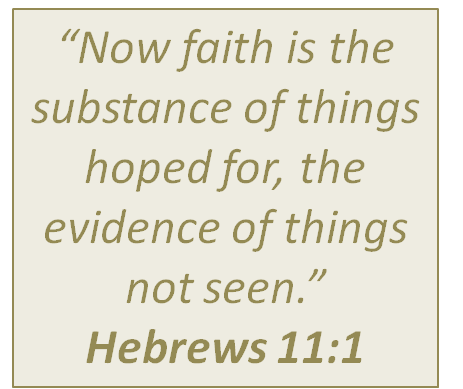
But, the question is why did Mary take such a risk? And, why did she take such a risk in 1861, the beginning of the civil war?  At the beginning of the civil war, no one even anticipated that a union victory in the war would lead to the end of slavery.  The war wasn’t even about ending slavery at that point, it was moreso about the economic and political battles between the North and South on cotton production and manufacturing.  So, it wasn’t like Mary was just holding on for four more years, with the assurance that teaching these slaves to read would be in preparation for the end of slavery if the North won in 1865.   No, she was doing this work in the absence of any real guarantees.  She was doing the work based on hope, and based on her FAITH.   Mary and others saw it as an opportunity to use their talents and skills to uplift the community.  She believed that she was preparing the slaves to become full citizens…one day.  She had FAITH that her work in teaching them to read would transform the slaves’ lives, but also go towards changing the fate of the nation.  If that isn’t a great example of FAITH, in absence of any reassurance or evidence, then I don’t know what is.  faith quote

I’ve often said that being an entrepreneur helps build your FAITH muscles like nothing else.  When it comes to being a social entrepreneur and leader of a non profit organization, I think that statement can be amplified times ten.  I’ve encountered so many challenges in running Polished Pebbles Girls Mentoring Program in the last four years.  It was a huge risk to leave my career in corporate America to pursue my passion.  And, it was such a huge risk to put myself out there and start Polished Pebbles with no real funding, no assurance of the necessary support, or that it would even be successful for that matter.  And quite frankly, it hasn’t gotten any easier to continue to grow our efforts mentoring girls and encouraging our community to do the same.  School and government budget cuts make servicing our communities in the same capacity, or greater, extremely hard.  How do you continue to commit to our girls, their families, our schools, when it’s hard to see how you can continue to commit to paying staff to do the work, and when it seems that the budget to do so is non-existent!

Family and friends know that when I get frustrated with the challenges in growing my organization, I often jokingly ask myself….”Now, why did I leave my job and my salary again?”  But, when I calm down and put things in perspective, I have to say to myself how can I not continue to persevere to be successful with Polished Pebbles even in seemingly dire circumstances such as the times we’re facing now.  I know that it’s been FAITH that’s gotten us this far, and it’ll be that same FAITH that will continue to transform the lives of the girls and communities we serve, and change the fate of education in our nation today.  Yes, I do get scared often, but how can I seriously consider giving up if I consider the life-threatening FAITH that our ancestors like Mary Smith Peake demonstrated to free us!  Just like Mary and her counterparts,  I will continue to see my work with Polished Pebbles as an opportunity to use my talents and skills to uplift the community.  And, just like Mary I must continue to believe that the work I do prepares our girls to fully realize the possibility of happy, successful, and prosperous lives.  And, that is a cause that worthy of the risks. 

Kelly

KellyFairTheMentor

Want to donate to Polished Pebbles Girls Mentoring Program?  Click here: Donate to Polished Pebbles

Want to get more tips and insight on mentoring urban youth and girls? Share and follow,http://www.kellyfairthementor.wordpress.com.  Want to join us with mentoring at Polished Pebbles?  Email us at info@polishedpebbles.

A Tale of Two Girls From Two Communities

vibe role models

Can we allow reality TV stars be the example of how women seem to NEVER get along?

this or that mentors

Do we as women in the community take the responsibility of doing the work to demonstrate for girls what REAL women working together looks like?

Examples of Women Working Together:

 Which example will we choose to exhibit for our girls? 

I’d like to share the story of two girls who both participated in Second Saturday’s Program of Polished Pebbles, the mentoring program I founded in Chicago.  The Second Saturday’s program is monthly workshop that is free and open to girls throughout Chicagoland, but it also includes a network of girls who participate in Polished Pebbles’ after school programs through out the year, at different partnering schools and communities.  Two girls from two different communities in Chicago, Altgeld Gardens and Dearborn Homes, met each other for the first time at the Second Saturdays Program, and struck up a friendship.  Let’s say their names are “Tenisha” &” Mariah.” That friendship that started at monthly Polished Pebbles meetings turned into calling each other, sending text messages, and even working together at the same summer job.

As funding for education and youth initiatives seems to be frequently under fire in under-resourced communities, at the beginning of this school year, it looked as though our service to three of the communities of girls we worked with for two years would be cut.  This meant that we would no longer be able to support the girls in the two communities that both “Tenisha” and “Mariah” resided in.  Potentially losing the opportunity to work with these girls was devastating, because we didn’t want to jeopardize the relationship we had built with the girls of these communities.  Additionally, many of our girls are facing so many challenges in their daily lives, including maintaining trust with people because they’ve been let down so often.  We didn’t want Polished Pebbles to be yet another group of adults who let them down and broke their trust.

When the word got out to the women who volunteer and mentor with Polished Pebbles they put their heads and resources together. The were firm in ensuring we would be able to continue to work with these girls no matter the obstacles.  Now, you must know this is a large and very eclectic group of women from different professions, backgrounds, neighborhoods, walks of life, veteran mentors, and women volunteering for the very first time.  But, all differences were put aside when the best interest of our girls were involved.  They raised the money to cover the costs for the girls to participate in the upcoming bowling trip, and the funds to bus them to our Second Saturday program throughout the school year.

Because of the support of these women working together, we are able to maintain our relationships with the three communities of girls .  Because of these women working together, the girls didn’t have to again experience abandonment and a lack of love.  The support of these women working together enables Polished Pebbles mentees to maintain their relationships with girls from different communities throughout Chicagoland that they’ve established in the Polished Pebbles Network.  And, because of these powerful women working together, the friendship between our two girls from two different communities, “Tenisha” & “Mariah”, is solidified even further.  Now, they can continue to SEE each other monthly and learn together at the Polished Pebbles Second Saturdays program-the place where they initially met.

sisterhood ucw

#sisterhood

As the Role Models and mentors in this group mentoring initiative, Polished Pebbles, or any mentoring program in any city for that matter, it is our duty to foster a culture of seamless relationships of WOMEN and GIRLS Working Together in unison and purpose.  From this story you can tell we’re doing just that.  But, the work isn’t done.  We have to constantly work to make sure that we are modeling what strong working relationships, friendships, and networks of women should look like, and that starts with how we plan and prepare for the work we do with our girls! Demonstrating positive examples of teamwork is definitely a “Cornerstone of Effective Mentoring.”  We can’t let the poor and misleading examples depicted in reality TV series be the only examples of how our girls see women, and women of color ,interact.  It’s a lot of work, but I’m encouraged.  What a wonderful journey we’re embarking upon.  I couldn’t be more excited to journey with a greater group of women!

Got my bags packed!

Kelly

KellyFairTheMentor

Want to get more tips and insight on mentoring urban youth and girls? Share and follow, http://www.kellyfairthementor.wordpress.com.  Want to join us with mentoring at Polished Pebbles?  Email us at info@polishedpebbles.